

Defending the Citadel of Justice
Defending the Citadel of Justice: The Supreme Court's Landmark Protection of Attorney-Client Privilege in In Re: Summoning of Advocates."The first thing we do, let's kill all the lawyers"—Shakespeare's memorable line from Henry VI, Part II, spoken by a rebel seeking democratic demolition, reveals a
LAW
When Silence Becomes Speech: A Constitutional Imperative
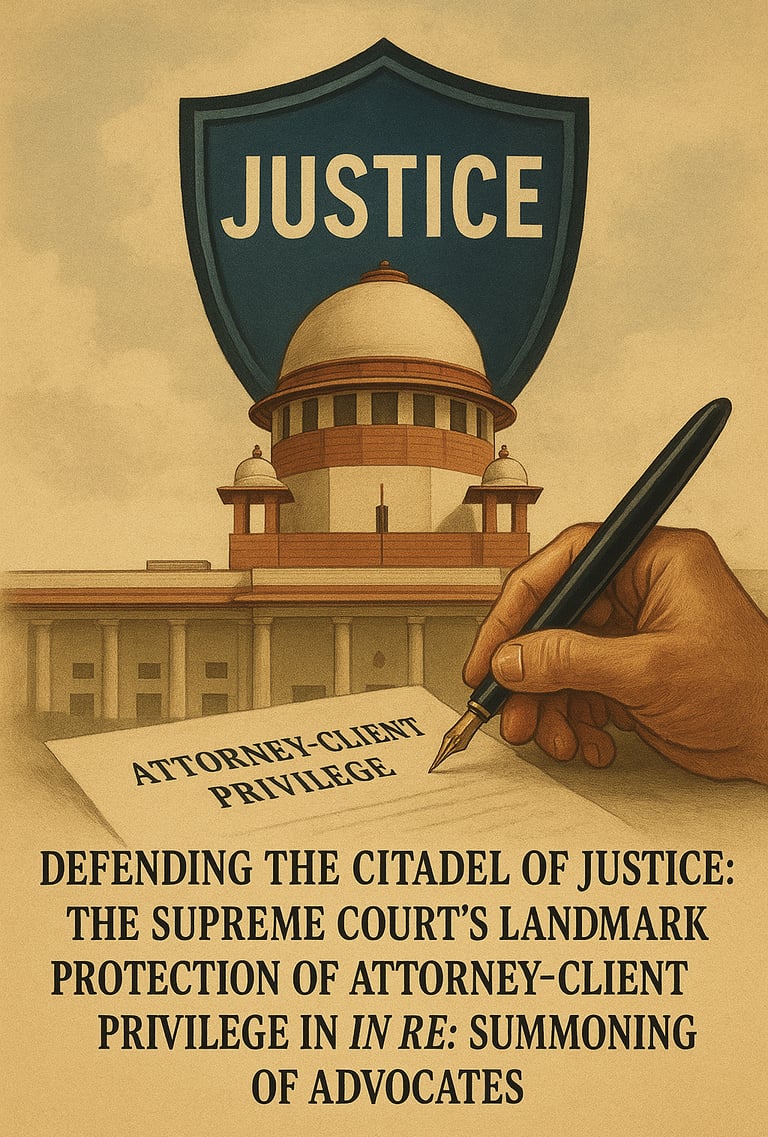
"The first thing we do, let's kill all the lawyers"—Shakespeare's memorable line from Henry VI, Part II, spoken by a rebel seeking democratic demolition, reveals a profound truth that Justice K. Vinod Chandran invoked in the Supreme Court's landmark judgment delivered on October 31, 2025. In a courtroom where justice must prevail, there exists a fortress that no investigating agency may breach without consequence: the sanctity of the attorney-client privilege.
The Court observed that disposing of lawyers represents a definitive step toward totalitarianism and authoritarianism. This philosophical opening framed a decisive defence of legal professionals against investigative overreach, fundamentally recalibrating the balance between state power and professional independence in India's criminal justice system. The judgment that followed would reshape how investigating agencies interact with the legal profession and establish enduring constitutional protections for attorney-client communications and legal privilege.
From Ahmedabad to the Supreme Court
The controversy originated from a routine investigation in Ahmedabad when an Assistant Commissioner of Police issued a notice under Section 179 of the Bharatiya Nagarik Suraksha Sanhita (BNSS), 2023, summoning a practising advocate regarding details of a case in which he represented the accused person. The matter involved a loan dispute under the Gujarat Money-Lenders Act, 2011, coupled with criminal charges under the Scheduled Castes and Scheduled Tribes (Prevention of Atrocities) Act, 1989.
The advocate had merely filed a regular bail application on behalf of his client, yet faced significant pressure to disclose highly confidential case details to the investigating authorities, despite his professional obligations to maintain client confidentiality and attorney-client privilege, as recognised under the law.
When the advocate approached the Gujarat High Court seeking relief and quashing the summons, he received an unsettling rejection from the bench. The High Court held that since the summons was issued under Section 179 of the BNSS, which empowers investigating officers to summon witnesses, there was no fundamental rights violation warranting intervention. This procedural reasoning masked a troubling and dangerous precedent that would have permitted investigating agencies to routinely summon counsel representing accused persons, fundamentally undermining attorney-client relationships and professional confidentiality standards long recognised in common law jurisdictions and democratic systems.
The matter gained urgent prominence when the Enforcement Directorate issued summons to two distinguished Senior Advocates of the Supreme Court, Arvind Datar and Pratap Venugopal, for providing legal opinions to clients regarding financial matters. Following vociferous protests from the Supreme Court Bar Association and SCAORA, the ED withdrew the summons and issued Technical Circular No. 03 of 2025, mandating prior approval from the Director for future summons to any advocate.
Yet this administrative response, while welcome from the legal community, was deemed insufficient to address systemic problems and create a binding legal framework applicable across all investigating agencies. A Division Bench comprising Justices K.V. Viswanathan and N.K. Singh referred the matter to the Chief Justice of India, leading to suo motu cognisance and constitution of a three-judge bench comprising Chief Justice B.R. Gavai, Justice K. Vinod Chandran, and Justice N.V. Anjaria to establish constitutionally sound principles.
The Court's Mandate: Dual Questions of Constitutional Import
The Court framed two questions of constitutional significance guiding its deliberation:
(i) When an individual's association with a case is solely as legal advisor to a party, could investigating agencies directly summon the lawyer for questioning without legal impediment?
(ii) Even assuming the investigating agency claims the individual's role transcends merely legal advice, should the agency directly summon the lawyer, or should judicial oversight be prescribed for exceptional cases requiring access? These questions encapsulated fundamental criminal justice tension—balancing investigative prerogatives with citizens' rights to confidential legal representation while protecting professional independence and rule of law itself in a democratic system.
The Statutory Framework: Section 132 of the Bharatiya Sakshya Adhiniyam
The judgment's legal foundation rests upon Section 132 of the Bharatiya Sakshya Adhiniyam (BSA), 2023, which replaced Section 126 of the Indian Evidence Act, 1872. Section 132 provides comprehensive protection, ensuring that advocates cannot disclose communications made during professional services, the contents of state documents acquired in a professional capacity, or disclose advice given in confidence to clients. Critical exceptions exist for communications made in furtherance of illegal purposes or facts showing crimes committed since service commencement, providing a necessary balance between privilege and public interest.
The provision's illustrations illuminate the scope comprehensively: where a client admits guilt and engages an advocate for defence, communication is protected because defending a guilty person is not a criminal purpose. Conversely, where a client seeks assistance in obtaining property through a forged deed, communication falls outside privilege as it furthers criminal activity. This balanced approach reflects the provision's careful calibration between professional duty and public interest, preserving the essential nature of legal representation.
The "Chilling Effect Doctrine" on Legal Independence
The judgment's most compelling aspect is the Court's acute recognition that the mere threat of an investigative summons fundamentally alters advocates' capacity to fearlessly represent clients and provide candid legal advice without fear of personal jeopardy. Justice Vinod Chandran observed that advocates representing accused persons face cascading consequences when they are questioned by police about case details or client admissions, as well as privileged communications made in confidence.
First, advocates face personal vulnerability potential professional misconduct charges for any disclosure, even if coerced by investigating officers during tough interrogation sessions. Second, clients become reluctant to confide sensitive information in lawyers, knowing they may face police pressure and questioning regarding privileged matters. Third, investigators may regard advocate fees as proceeds of crime, justifying a summons ostensibly investigating financial impropriety when the real motive is accessing privileged communications through investigative pressure and coercive tactics employed against the profession.
This dimension reveals why the judgment transcends technical legal analysis it concerns criminal defence architecture and foundational trust between lawyer and client, essential for justice system functioning. When advocates cannot guarantee confidentiality, the entire edifice of right to legal representation crumbles into meaninglessness and dysfunction. The Court declared: "The power to summon under Section 175 & 179 is not the power to interfere with privileged communications between lawyer and client, as long as Constitutional Courts sit in this Country." This represents constitutional commitment asserting judiciary's guardian role includes protection against state overreach into professional spaces foundational to justice and democratic accountability in governance.
The Court's Verdict: Four Substantive Directions
The Court issued four substantive directions:
Direction 1 established that investigating officers cannot summon advocates unless matters fall under Section 132's exceptions, requiring superior officer consent and written satisfaction (not below the rank of Superintendent of Police or its equivalent).
Direction 2 clarified that documents themselves are not privileged, though their contents may be.
Direction 3 directed digital device production to Jurisdictional Courts with protective protocols.
Direction 4 excluded in-house counsel from Section 132 protection but granted them Section 134 protections.
Conclusion: Constitutional Anchor for Democratic Order
The judgment stands as a constitutional anchor, affirming that the rule of law entails a substantive commitment to limit state power and ensure that legal representation remains inviolable through proper judicial oversight and the constitutional protection of the advocate-client privilege relationship, which is essential to the pursuit of justice.
The judgment in In Re: Summoning of Advocates (2025 LiveLaw (SC) 1051) is a vindication of constitutional principle, albeit delivered through carefully calibrated statutory interpretation. By refusing to issue guidelines (thus respecting judicial limits and Article 14) while simultaneously issuing substantive directions (thus protecting attorney-client privilege and constitutional rights), the Court has achieved a remarkable synthesis.
Justice Vinod Chandran's opening invocation of Shakespeare and the insight that disposing of lawyers is a step toward totalitarianism frames the judgment's true significance. It is not primarily about protecting the professional interests of lawyers. Rather, it is about protecting the constitutional architecture of liberal democracy, within which an independent legal profession capable of fearlessly representing all citizens (regardless of reputation or charge) is non-negotiable.
In an era when investigative agencies wield unprecedented power, when digital surveillance is omnipresent, and when the line between legitimate investigation and oppressive scrutiny blurs, this judgment stands as a constitutional anchor. It affirms that the rule of law is not merely a formal adherence to legal procedures, but a substantive commitment to limiting state power, protecting individual rights, and ensuring that legal representation —the bridge between citizen and court remains inviolable.
The Supreme Court has thus returned to Tocqueville's profound insight: the legal profession is democracy's safeguard. Where lawyers can be summoned at will for defending their clients, democracy recedes. Where lawyers can counsel their clients fearlessly and in confidence, justice flourishes. The directions issued in this judgment, though seemingly procedural, are therefore foundational to the constitutional order itself.
Views are personal.

Connect with us on:


BeyondCLAT By VEDverse
© 2025 Beyondverse. All rights reserved. | Rewiring Education, One Student at a Time.
Testimonials | Program Details | Privacy Policy | Feedback