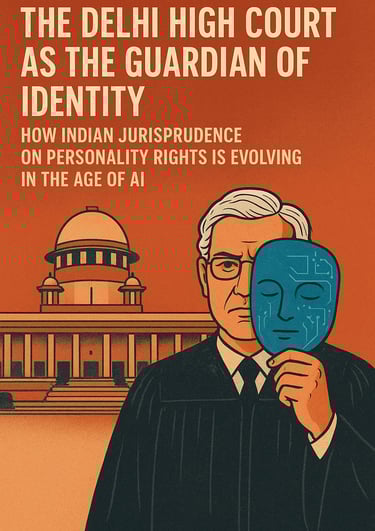
The Delhi High Court as the Guardian of Identity: How Indian Jurisprudence on Personality Rights is Evolving in the Age of AI
In a revolutionary shift in Indian intellectual property and constitutional law, the Delhi High Court has become the central battleground for safeguarding celebrity identity. From 2023 to 2025, a torrent of petitions from Bollywood performers, musicians, filmmakers, and spiritual leaders inundated the Court, each requesting judicial protection from the growing threat of AI-created deepfakes, digital impersonation, and unauthorised commercial use of their image, voice, and persona.
LAW
1. A New Legal Frontier: When Fame Becomes a Liability
1.1 The Birth of a Modern Legal Phenomenon
In a revolutionary shift in Indian intellectual property and constitutional law, the Delhi High Court has become the central battleground for safeguarding celebrity identity. From 2023 to 2025, a torrent of petitions from Bollywood performers, musicians, filmmakers, and spiritual leaders inundated the Court, each requesting judicial protection from the growing threat of AI-created deepfakes, digital impersonation, and unauthorised commercial use of their image, voice, and persona.
What differentiates this growth from traditional intellectual property conflicts is its integration of technology, constitutional rights, and tort law. The Court's method has transcended singular adjudication; it is building a new jurisprudential architecture that answers a deeply contemporary question: who owns your identity in an era when technology can duplicate it with ease?
2. Understanding Personality Rights: The Anatomy of Legal Protection
Personality rights, or the right of publicity, are the legal right of an individual to manage and derive benefit from the commercial exploitation of his or her identity traits like name, image, likeness, voice, and signature. They exist at the nexus of economic value and human dignity and differ from the general right of privacy.
2.1 The Right to Publicity
This element protects against unauthorised commercial exploitation of an individual's image, be it through advertisements, endorsements, or merchandising. It recognises that fame generates quantifiable economic value, and only the celebrity has the right to decide how that value is to be capatilised and employed.
2.2 The Right to Privacy
Derived from Article 21 of the Indian Constitution, 1950, this aspect safeguards individuals from unwanted exposure, distortion, or misrepresentation, ensuring that one's image and identity are consistent with their dignity and autonomy.
opposite to the codified rights such as trademarks or copyrights, personality rights in India have developed organically through judicial interpretation. This common law course, while elastic, has resulted in fragmentation and doctrinal incompleteness, as courts resolve the tension between freedom of expression under Article 19(1)(a) and privacy and dignity under Article 21.
3. The Constitutional Foundation: From Auto Shankar to Puttaswamy
The history of Indian personality rights jurisprudence begins with the Supreme Court's trailblazing ruling in R. Rajagopal v. State of Tamil Nadu ((1994) 6 SCC 632) (Auto Shankar case)[i]. The Court ruled that the right to control the use of one's name and image is part of the right to privacy and defined it as the "right to be let alone.This was the first of the constitutional recognition that a person's identity cannot be used without consent.
This doctrine was further elaborated in Justice K.S. Puttaswamy (Retd.) v. Union of India ((2017) 10 SCC 1)[ii] , wherein a nine-judge bench of the Supreme Court unequivocally enshrined privacy as a basic right under Articles 14, 19, and 21 of the Constitution of India, 1950. Justice D.Y. Chandrachud's majority judgment defined privacy to encompass "decisional autonomy the ability to autonomously decide what part of one's identity is revealed or commodified. Significantly, Justice A.K. Sapre's concurring opinion clearly labelled personality rights as an extension of Article 21 of indian contitution, hence constitutionally grounding them in the right to life and personal liberty.
4. The Delhi High Court’s Evolving Jurisprudence on Personality Rights in the Age of AI
The Delhi High Court’s progressive jurisprudence on personality rights most notably crystallised in Anil Kapoor v. Simply Life India & Ors. (2023 SCC OnLine Del 6914) [iii], firmly positioning India among jurisdictions recognising the intersection of intellectual property and constitutional rights in protecting personal identity. Justice Prathiba M. Singh’s reasoning in this seminal case, reinforced by subsequent decisions, lays the foundation of a coherent doctrine rooted in dignity, privacy, and proprietary control over one’s persona.
4.1 The Foundational Ruling: Anil Kapoor v. Simply Life India & Ors. (2023 SCC OnLine Del 6914)
In one of the most comprehensive articulations of personality rights in the digital era, the Delhi High Court, in Anil Kapoor v. Simply Life India & Ors. delivered by Justice Prathiba M. Singh, addressed the unauthorized use of actor Anil Kapoor’s persona including his name, image, voice, acronyms like “AK,” and signature expressions such as “Jhakaas.” The infringements ranged from merchandise and ringtone sales to sophisticated AI-generated deepfakes and morphed pornographic content.
“The court cannot turn a blind eye to misuse of a personality’s name and other elements of their persona. Dilution, tarnishment, and blurring are actionable torts that a celebrity must be protected against.”*
Crucially, the Court distinguished between legitimate free speech under Article 19(1)(a), which protects information, parody, or genuine criticism, and infringing conduct that tarnishes or jeopardises a person’s reputation. Justice Singh explicitly recognized the threats posed by emerging technologies: “Technological tools now available make it possible for any illegal and unauthorised user to make use of any celebrity's persona by using such tools including AI.”
Under Order XXXIX Rules 1 and 2 of the Code of Civil Procedure, 1908, the Court issued an in rem injunction restraining the misuse of Kapoor’s persona via AI, deepfakes, GIFs, or morphing. Domain names bearing his name were ordered to be blocked, suspended, and transferred, establishing a strong enforcement precedent.
4.2 Jackie Shroff v. The Peppy Store & Ors. [iv]
In Jackie Shroff v. The Peppy Store & Ors., the Delhi High Court, by Justice Sanjeev Narula, extended the Anil Kapoor precedent to cover impersonation through AI. The actor claimed protection for his name, voice, photos, and use of his catchphrase "Bhidu" against misuse by e-commerce players and AI chatbots mimicking his personality.
A defendant had initiated an AI chatbot imitating the actor's speech pattern and personality—a clear invasion of his personality rights. Realizing this, the Court restricted such unauthorized use while taking a balanced approach towards artistic and economic expression. Justice Narula refused to grant an ex parte injunction against a YouTube creator, keeping in mind that rights under Article 19(1)(a) should be balanced against a celebrity's right to publicity and moral integrity.
Drawing from D.M. Entertainment Pvt. Ltd. v. Baby Gift House (2010 SCC OnLine Del 4790), the Court reiterated that publicity rights include the control over commercial utilization of one's name, appearance, and voice. Relief was ordered against unauthorized products, manipulated videos, and AI chatbots, with directions for blocking infringing URLs and products under the Copyright Act, 1957 and Trade Marks Act, 1999.
4.3 Amitabh Bachchan v. Rajat Negi & Ors. (2022)[v]
Prior to Anil Kapoor, the Delhi High Court's ruling in Amitabh Bachchan v. Rajat Negi & Ors. established procedure for sweeping, pre-emptive injunctions in personality right protection. Bachchan attempted to enjoin websites and mobile apps from invoking his picture and name in impersonation scams using him and the TV show Kaun Banega Crorepati (KBC).
The Court issued an ex parte ad interim omnibus injunction under Order XXXIX, Rules 1 and 2 CPC restraining all unauthorised uses of his persona. The Ministry of Electronics and Information Technology and Internet Service Providers were ordered to block offending URLs and numbers. The ruling created a precedent for in rem protection, issuing injunctions that bind all infringers, not simply identified defendants.
5. The 2025 Surge: Expanding the Frontiers of Personality Rights
In 2025, the Delhi High Court witnessed a record surge in celebrity-led litigation, reflecting both increasing judicial acknowledgment of personality rights and the growing threat of AI-based impersonation..
5.1 Aishwarya Rai Bachchan v. John Does (2025) [vi]
In Aishwarya Rai Bachchan v. John Does, Justice Tejas Karia noted that unauthorised use of personal characteristics is in breach of Article 21, denting the dignity and privacy of a person. The Court directed the removal of offending URLs in 72 hours and granted interim injunctions against AI-sourced abuse of the actor's image and persona, reaffirming the Anil Kapoor standard.
5.2 Abhishek Bachchan v. John Does (2025) [vii]
In Abhishek Bachchan v. John Does, the celebrity sued for unauthorized sale of products bearing celebrity images. The Court gave importance to the commercial aspect of personality rights under the Trade Marks Act, 1999, holding that the acts constitute unfair competition and dilution of goodwill.
5.3 Hrithik Roshan v. Ashok Kumar & Ors. (2025) [viii]
In Hrithik Roshan v. Ashok Kumar & Ors., Justice Manmeet Pritam Singh Arora took a sharp distinction between commercial exploitation and fan non-commercial expression. While directing take-down of infringing AI-generated works and merchandise, she declined to direct take-down of fan pages at the ex parte stage, noting that "Instagram use is not only commercial.". Individuals engage in it for recreation and entertainment." Such a sophisticated position represented a transition away from pure protectionism to an informed appreciation of the celebrity-fan relationship.
5.4 Kumar Sanu Bhattacharjee v. Jammable Limited & Ors. (2025) [ix]
Justice Manmeet Pritam Singh Arora in Kumar Sanu Bhattacharjee v. Jammable Limited & Others, enlarge personality rights protection to voice artists, spotted that the voice itself as a protectable aspect of persona. The playback singer while asserts that defendants were employing AI voice cloning technology to imitate his style of singing, infringing Sections 38A and 38B of the Copyright Act, 1957, which protect performers' moral rights.
5.5 Sadhguru Jaggi Vasudev v. Rogue Websites & Ors. (2025) [x]
In Sadhguru Jaggi Vasudev v. Rogue Websites & Ors., Justice Saurabh Banerjee introduced the innovative concept of a “dynamic+ injunction”, an enhanced form of injunctive relief extending automatically to future infringing content. The spiritual leader sought protection against deepfakes, voice clones, and AI-generated videos misrepresenting his endorsements and activities.
6. The Fascinating Angle: Why Delhi High Court is the Chosen Forum
The growing concentration of personality rights litigation before the Delhi High Court is far from coincidental it reflects a strategic convergence of jurisprudential depth, institutional capacity, and procedural flexibility. In the AI era, where digital replication blurs the line between authenticity and imitation, the Delhi High Court has become the most trusted guardian of identity ensuring that the law remains as human as the identities it protects.
6.1 Early Jurisprudential Leadership
Delhi’s prominence began with D.M. Entertainment Pvt. Ltd. v. Baby Gift House & Ors. (2010 SCC OnLine Del 4790)[xi] , where Justice Ravindra Bhat first recognized Daler Mehndi’s persona as a quasi-property right with commercial value. This was followed by Titan Industries Ltd. v. M/s Ramkumar Jewellers (2012 (50) PTC 486 (Del))[xii], where Justice Manmohan affirmed that unauthorized use of celebrity identity constituted passing off. These decisions formed the template for contemporary personality rights protection, which was subsequently echoed in cases involving Amitabh Bachchan, Anil Kapoor, and Jackie Shroff.
6.2 Institutional and Jurisdictional Advantages
Delhi has long established been India's IP capital, with skilled practitioners, academic interest, and proximity to the Central Government that equipped it with speedy enforcement. Its jurisdictional provisions under Section 134 of the Trade Marks Act, 1999, and Section 62 of the Copyright Act, 1957, give leverage to plaintiffs to sue where they live or business is done appealing to Delhi even for cross-jurisdictional cases. In addition, under the cyber scenario, Section 20 of the Code of Civil Procedure, 1908, provides that infringement available over the internet effectively grants Delhi jurisdiction over national violations.
6.3 Specialized IPR Division and Predictable Jurisprudence
The institutionalisation of expert adjudication has been facilitated through the creation of the Intellectual Property Rights Division under the Tribunals Reforms Act, 2021, and the Delhi High Court IPR Division Rules, 2022. This system assures efficiency, consistency, and e-awareness, which are the core characteristics for arbitrating AI-age disputes. As Ameet Naik of Naik Naik & Company rightly points out, "Orders from the Delhi High Court have become the foundation for every subsequent celebrity rights case in India."
In essence, Delhi’s High Court is not just a forum; it is the nerve centre of India’s evolving identity jurisprudence, where technology, personality, and law intersect under one progressive roof.
7. A Patchwork Legal Framework
India’s protection of personality rights is a judicial construct, not a legislative one. The framework is spread across multiple statutes and constitutional guarantees:
Article 19(1)(a) of the Indian Constitution, which protects freedom of expression, including control over the commercial exploitation of one’s identity.
Article 21 of the Indian Constitution, which ensures the right to privacy and dignity, as interpreted in Justice K.S. Puttaswamy (Retd.) v. Union of India, (2017) 10 SCC 1.
Trade Marks Act, 1999, which Recognise celebrity names, voices, and signatures as protectable marks.
Copyright Act, 1957 (Sections 38A & 38B) , which grants performers moral and economic rights against distortion or misuse.
Code of Civil Procedure, 1908 (Order XXXIX Rules 1 & 2) , which enables interim and dynamic injunctions to prevent ongoing digital misuse.
Information Technology Act, 2000, which provides limited safeguards against online impersonation and intermediary liability.
Despite these tools, India lacks a unified Statute on Personality Rights, leading to uncertainty over the scope, transferability, and posthumous rights.
8. The Road Ahead
The Delhi High Court's progressive jurisprudence on personality rights is one of the most progressive developments in Indian law. Through a complex interplay of Articles 19 and 21 of the Constitution of India, 1950, the Trade Marks Act, 1999, the Copyright Act, 1957, and the principles of common law, the Court has established a nuanced, person-centred methodology for safeguarding individual identity in the digital age.
The recent proliferation of celebrity litigation is not a fleeting phenomenon but a juridical reaction to technological upheaval. While AI, deepfakes, and synthetic media risk making identity commercially exploitable, the Court's nimble injunctions under Order XXXIX of the Code of Civil Procedure, 1908, signal an innovative judiciary evolving in response to age-old harms. However, this transformation requires statutory support a robust Personality Rights Act delimiting duration, transferability, reasonable use boundaries, and platform responsibility.
International examples, ranging from California's post-mortem rights legislation to Europe's dignity-oriented GDPR protections, provide helpful models. India can adopt a blended approach, striking a balance between commercial protection and human dignity.
Finally, the Delhi High Court has shifted from being an adjudicator to an architect of contemporary identity law, reaffirming a deep constitutional insight: in today's digital world, one's persona is property, and its protection is an issue of dignity and democracy in equal proportion.
Bibliography
[i] R. Rajagopal v. State of Tamil Nadu, (1994) 6 SCC 632 – SCObserver/LiveLaw
[ii] Justice K.S. Puttaswamy (Retd.) v. Union of India, (2017) 10 SCC 1 – SCObserver
[iii] Anil Kapoor v. Simply Life India & Ors., 2023 SCC OnLine Del 6914 – LiveLaw
[iv] Jackie Shroff v. The Peppy Store & Ors., 2024 SCC OnLine Del __ – LiveLaw
[v] Amitabh Bachchan v. Rajat Negi & Ors., 2022 – LiveLaw
[vi] Aishwarya Rai Bachchan v. John Does, 2025 – LiveLaw
[vii] Abhishek Bachchan v. John Does, 2025 – LiveLaw
[viii] Hrithik Roshan v. Ashok Kumar & Ors., 2025 – LiveLaw
[ix] Kumar Sanu Bhattacharjee v. Jammable Limited & Ors., 2025 – LiveLaw
[x] Sadhguru Jaggi Vasudev v. Rogue Websites & Ors., 2025 – LiveLaw
[xi] D.M. Entertainment Pvt. Ltd. v. Baby Gift House & Ors., 2010 SCC OnLine Del 4790 – Case
[xii] Titan Industries Ltd. v. M/s Ramkumar Jewellers, 2012 (50) PTC 486 (Del) – Case

Connect with us on:
BeyondCLAT By VEDverse
© 2025 Beyondverse. All rights reserved. | Rewiring Education, One Student at a Time.
Testimonials | Program Details | Privacy Policy | Feedback